Your scan came back clear. The fracture healed. The strain settled down. And somebody told you, perfectly kindly, that whatever you did to it would have mended months ago.
So why are you still shifting about in your chair by eleven in the morning? Why are you thinking about the drive before you've even got in the car, still waking up at three and working out how to roll over without setting it off? Most people I see have stopped mentioning it to anybody, because saying "I'm fine" is a lot easier than explaining it all again.
I've sat across from a lot of people who have been told, one way or another, that there's nothing wrong with them. Most of them walk out feeling worse than when they came in, because they know perfectly well what they're feeling. They're not making it up. They're not being soft. And they're certainly not making a fuss.
Have a think about your own week
You'll probably recognise this one. Bending down to load the dishwasher doesn't bother you at all on a Saturday, and then on Wednesday afternoon the same bend nearly puts you on the floor. The drive to work hurts more than the identical drive to see friends at the weekend. You have a couple of bad nights and everything gets louder. You go away for a week and it quietens down, and then it's waiting for you again on the Monday.
Nothing happened to your tissue in between. Discs and tendons don't repair themselves on a Friday and tear again on a Monday. That simply isn't how they work.
So if pain were just a reading off the damaged part, like a fuel gauge, none of that would be possible. The same movement through the same tissue would hurt exactly the same amount every time. It doesn't, and that isn't you being inconsistent or imagining it on the bad days. It's actually the biggest clue we have about what pain really is.
Your pain is real. It just isn't a measurement of how damaged you are.
Pain and damage aren't the same thing
The International Association for the Study of Pain writes the definitions the rest of us work from, and there are two notes alongside their definition that I'd want you to see. The first says: "A person's report of an experience as pain should be respected." The second says: "Pain and nociception are different phenomena. Pain cannot be inferred solely from activity in sensory neurons."
That second one is a bit of a mouthful, so here's what it means. Nociception is the danger signal your tissues send up. Pain is what you actually end up feeling. The two are connected, but they're not the same thing, and nearly all the confusion about long-standing pain lives in the gap between them.
David Butler and Lorimer Moseley have spent their careers closing that gap for patients rather than for academics, and their book Explain Pain sums the whole thing up in a sentence: pain is always real, but it isn't always a sign of damage.
You're also in a lot of company. Pool the UK population studies together and something like 43 in every 100 adults are living with pain that's lasted longer than three months, with somewhere between 10 and 14 in every 100 having pain that genuinely disables them. It's a big crowd, and a very quiet one.
Your body's alarm system has three arms
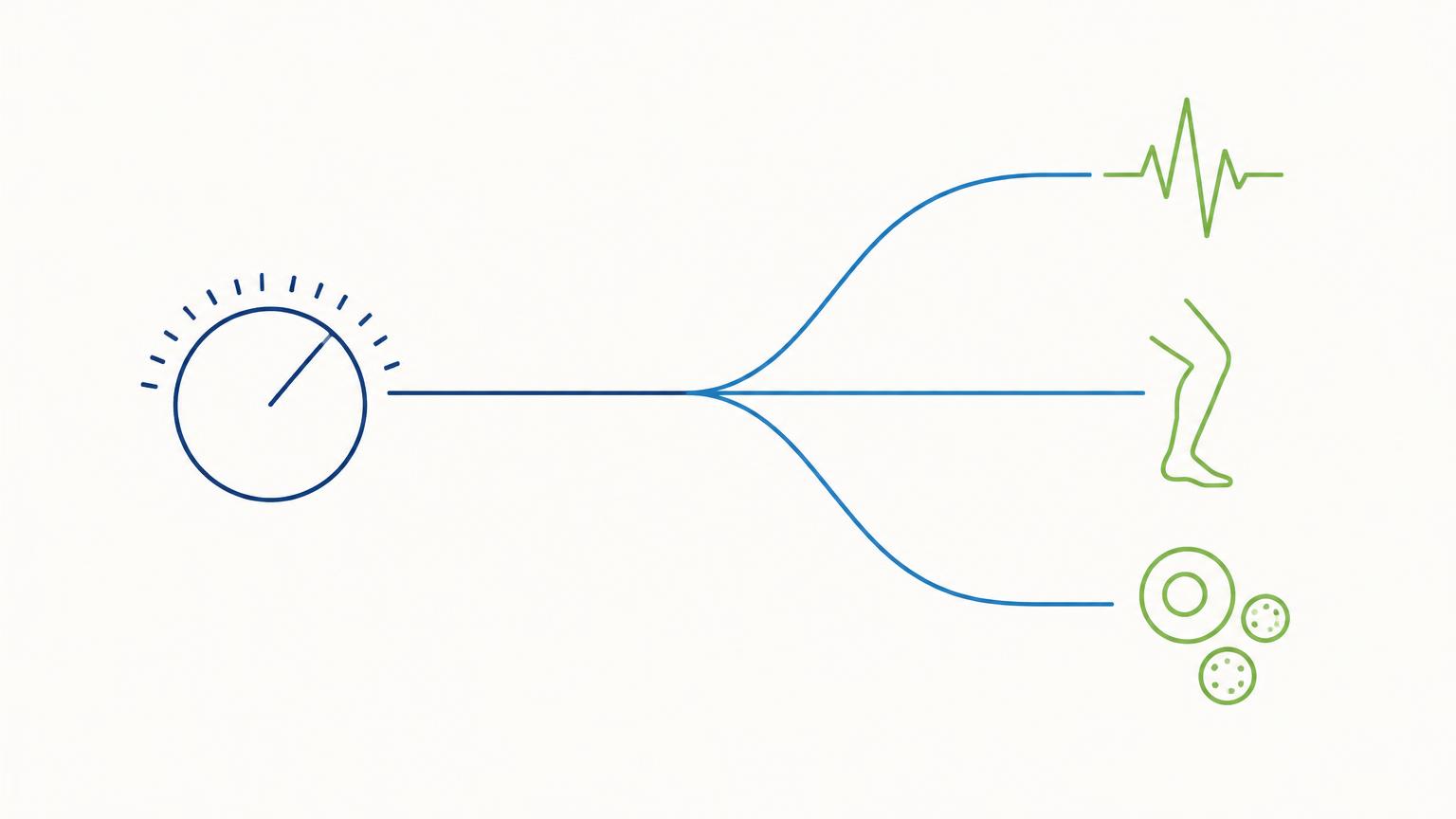
It helps to stop thinking of pain as a reading off a damage sensor and start thinking of it as a decision. Your body is deciding how much protecting you need. That decision doesn't get made in your back or your knee, and once it's made, your body acts on it in three ways at once. You'll recognise all three.
It winds you up. Heart going, breathing high and shallow, braced before you've even moved. Sleep gets lighter and shorter, which matters more than people realise, because the night is when a lot of your repairing is meant to happen. This is why a rough week at work genuinely makes your back worse. You're not imagining it because you're under pressure. The alarm is simply set more sensitively that week.
It changes how you move. Your muscles start working differently in order to protect you. The research puts it plainly: pain turns down the muscle that's supposed to be doing the job and turns up the one pulling the other way, so the movement gets smaller, which guards the area and helps it heal. That's a brilliant bit of design for a fortnight. Keep it going for two years and you pay for it. You move less, you move worse, and bits of you that were perfectly fine end up stiff, weak and irritable purely from being held carefully for eighteen months. The protection ends up being the problem.
It brings your immune system into it. This is the part that surprises people most. Pain isn't only a nerve story. The reviews of how the immune and nervous systems talk to each other now describe that conversation, between immune cells, glia and nerve cells, as indispensable to chronic pain both starting and carrying on. And there's one finding in that work worth reading twice. In inflammatory arthritis, the pain behaviour turns up before there's anything to see in the joint at all, and it carries on for weeks after the inflammation has gone.
Why the alarm stays on after the damage has gone
In plain terms, your nervous system gets better at its job. The nerve endings out in the tissue start firing more easily than they should, which is called peripheral sensitisation. And the nerve cells in your spinal cord and brain start responding more strongly to the same message coming in, which is central sensitisation.
Or to put it another way, your body has turned the volume up on its own alarm. The alarm is louder, but there isn't any more smoke.
That's usually the moment it clicks for the people I treat. Nothing new has gone wrong with you. The system that reports the problem has just got very good at reporting it, and it's carried on doing that after the thing it was built to report has gone. It's common enough that there's a formal medical category for pain that outlasts the healing.
This isn't me telling you it's in your head
I want to be careful here, because this is where people quite reasonably stop listening.
A sensitised nervous system is a physical change in a physical system. It isn't attitude. It isn't imagination. And it isn't something you can fix by having a better outlook on a Monday morning. What you're feeling is being produced by a body doing exactly the job it was built to do, a bit too well, for a bit too long.
What it does mean is that the target has been wrong. If the real problem is a protective system that's learned to stay switched on, then poking away at the sore spot forever isn't going to sort it, and neither is another scan of tissue that healed a year ago.
Understanding it actually changes it
I don't mean that as encouragement. I mean it turns up in the trials.
When people with long-standing back pain are properly taught how pain works, the pooled results across randomised trials show their pain comes down and their disability comes down, and their fear of moving drops a long way. It's still down when they're followed up later.
There's a limit to it, and I'd rather tell you than leave it out. A review of the whole field found that the teaching on its own didn't get people significantly better. The improvement came when the explanation was added to hands-on treatment and to getting people moving again. Understanding why you hurt is what makes the rest of the work possible. It doesn't do the work for you. That's exactly why we do both, in that order.
Three things you can do this week
Stop treating every flare-up as fresh damage. Next time it kicks off, ask yourself what your alarm has had to put up with lately. A couple of bad nights, a deadline, a week stuck at a desk. Those things genuinely turn the volume up. Noticing that isn't talking yourself out of the pain, it's reading the right dial.
Move in doses you'd be happy to repeat tomorrow. Guarding it is a sensible answer to a sprain and an expensive answer to a year. Whatever you can do again tomorrow will beat the big session that costs you three days.
Get an explanation you can repeat. If you can't tell your other half in one sentence why you're hurting, you haven't really been given an explanation yet. Go back and ask for one.
How we go about it at BodyCare
We start with a proper history, because the answer is usually in the story, and because the shape of your week tells us how sensitive things have become. We test the whole picture rather than just the sore bit. We measure things and then measure them again, so when you're improving we can show you rather than just tell you. You'll get a straight answer about what's driving it and roughly how long it ought to take, in words you can repeat to somebody else. And then we do the work with you, because the explanation on its own isn't the treatment. If what you need is outside what we do here, we'll say so and point you to the right person.
When not to wait
A few things need seeing straight away rather than next week. If your back or leg pain spreads to both legs, if you get new trouble with your bladder or bowels, if you go numb around the back passage, genitals, buttocks or inner thighs, if there's sexual dysfunction, or if both legs are getting weaker, go to A and E and get looked at the same day. And if you feel generally unwell alongside the pain, have a word with your GP.
If this sounds like you
You've probably been told there's nothing wrong. There is something wrong. It just isn't where everybody has been looking for it.
Book an assessment with us at BodyCare. We'll work out what's actually driving it, explain it to you in a way you can repeat to somebody else, and get on with treating it properly. Give us a ring on 01638 724042 or book online.