There is a phrase we hear almost every week, usually from someone who has already been round the houses. They have seen someone, had a scan or been refused one, tried a few painkillers, and been sent away with a label: non-specific low back pain. It sounds official. It sounds like an answer. It is not. It is the medical shorthand for "we could not work out what is causing it", dressed up as though the absence of a cause were a diagnosis in its own right.
Your back is not non-specific. The label is. And the two are very different things.
What "non-specific" actually means
Around eight or nine out of ten people who see someone about low back pain will be told it is non-specific. In fairness, the term does one useful job. It means the clinician has ruled out the small number of serious, specific diseases that occasionally cause back pain, things like fracture, infection or a tumour. That part is genuinely reassuring, and it is worth having confirmed.
But here is where it goes wrong. Ruling out the sinister causes is not the same as finding the actual one. "Non-specific" does not mean there is nothing driving your pain. It means nobody has yet identified what, in your particular back, is driving it. The reason has not been found. That is a very different message from the one most people walk away with, which is that their pain is a mystery they simply have to live with.
There is always a reason a back hurts. Tissue does not produce pain for no cause. The honest challenge is that the cause is often a pattern rather than a single, tidy structure you can point to on a scan, and finding a pattern takes a proper assessment. It is easier to write "non-specific" and hand over a generic sheet of exercises. Easier is not the same as right.
Why the label keeps you stuck
A generic label leads to generic treatment. Rest it, take some anti-inflammatories, here are some standard core exercises, it should settle in six weeks. For some people it does settle, because a lot of back pain calms down on its own regardless of what anyone does.
The problem is what happens next. Low back pain is one of the most recurrent conditions we see. Most people who have one episode will have another, and then another, each one arriving out of nowhere and easing off again without anyone ever explaining why. That is not bad luck. That is what happens when the symptom is treated and the driver is left completely untouched. The fire gets put out, but nobody turns off the gas.
Being told your pain is non-specific quietly gives everyone permission to stop looking. That is the real cost of the label. It closes the investigation at exactly the point it should be opening.
There is always a driver, and these are the usual suspects
When we assess a back properly, we are not chasing a mystery. We are working through a fairly well-known list of things that drive low back pain, and sorting out which ones are at play for you.
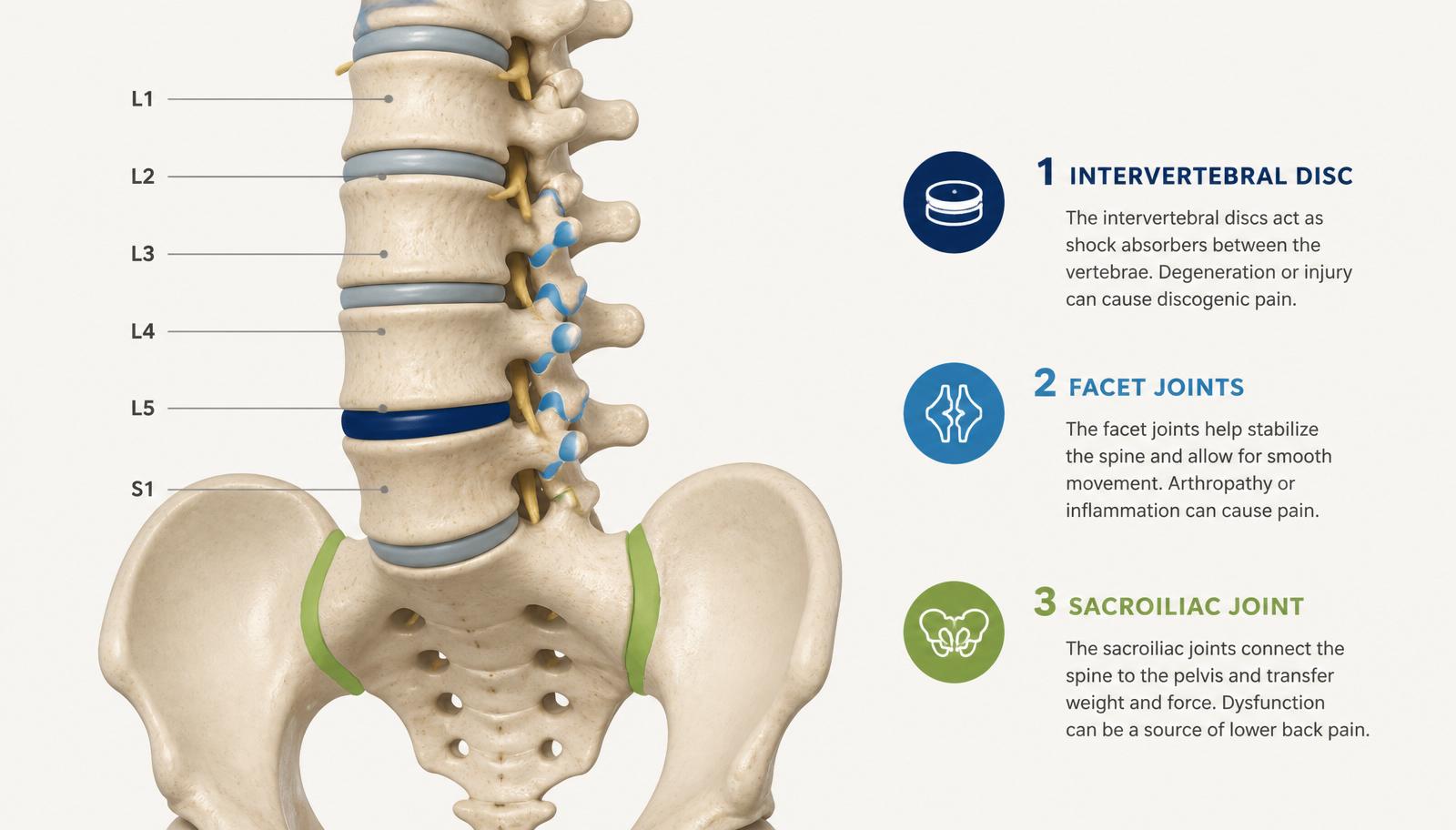
The disc. Discogenic pain typically feels worse with sitting, bending forwards and the first movements of the morning, and eases when you stand or walk. This is the group who often do well with a targeted, non-surgical disc approach rather than being left to hope.
The facet joints. The small joints at the back of the spine tend to complain in the opposite pattern, worse with standing for long periods, arching backwards or twisting, and often felt more on one side.
The sacroiliac joint. Pain sitting low, below the belt line and off to one side, often aggravated by rolling over in bed, standing on one leg or getting in and out of the car.
Muscle, load and conditioning. A back that has been asked to do too much too soon, or far too little for too long, will let you know. Deconditioning is a genuine driver, not a throwaway line.
The hip. A stiff or arthritic hip changes how you move and quietly forces the lower back to take up the slack. Treat the back in isolation and it keeps coming back, because the hip was the real culprit.
Movement and posture patterns. Often the tissue that hurts is simply the one at the end of a chain, overloaded by how you sit, lift, stand or move. Find the pattern and you find the cause.
Frequently it is a combination of these, and the exact tissue matters far less than understanding what loads your back and what settles it. That map, what makes it worse, what makes it better, how it behaves across a day, is the thing a proper assessment is built to draw. It is also the thing "non-specific" skips entirely. Nerve-driven leg pain such as sciatica, or the walking-limited leg heaviness of spinal stenosis, are two more examples of patterns that get missed inside a "non-specific" label.
When back pain is not something to sit on
Almost all back pain is safe to assess and treat, and most of it responds well. There is a short list of warning signs, though, that mean you should not wait for an appointment and should seek urgent medical care the same day, at A&E if needed:
- Numbness or pins and needles around the saddle area, the groin or the back passage
- Any loss of control of your bladder or bowels, or difficulty passing urine
- Numbness or weakness spreading down both legs
- Back pain alongside an unexplained fever, or unexplained weight loss
These are rare, but they are the exceptions that need immediate attention rather than a wait-and-see approach. If none of them apply, the sensible next step is a proper look at what is actually going on.
How we find your cause, not just your label
This is where we work differently. When you come in with back pain, we are not trying to fit you to a label someone else gave up on. We are assessing you.
We take a proper history, because how your pain behaves across a day tells us more than most scans do. We test how your spine actually moves, to find the direction and the load that provoke it and the ones that ease it. We look at the whole chain above and below, the hips, the pelvis and even the feet, because the back is very often the victim rather than the villain. Where soft tissue is in question, our in-clinic diagnostic ultrasound lets us look directly at the structures in real time rather than guessing. And where the disc is the driver, we can offer IDD Therapy, a specific non-surgical treatment aimed at the actual problem, not a generic protocol.
The point of all of it is simple. We treat the cause we have found, rather than the label you were handed. That is the difference between a back that settles and stays settled, and one that keeps dragging you back to square one every few months.
Get an actual answer
If you have been told your back pain is non-specific and you are still hurting, take that as your signal. It does not mean your pain is imaginary or untreatable. It means the cause has not been found yet, and that is a solvable problem.
Book an assessment with us at BodyCare. We will work out what is actually driving your pain, look at the whole picture rather than the sorest spot, and give you a clear plan to deal with it. Call us on 01638 724042 or book online. There is a reason your back hurts. Let us find it.