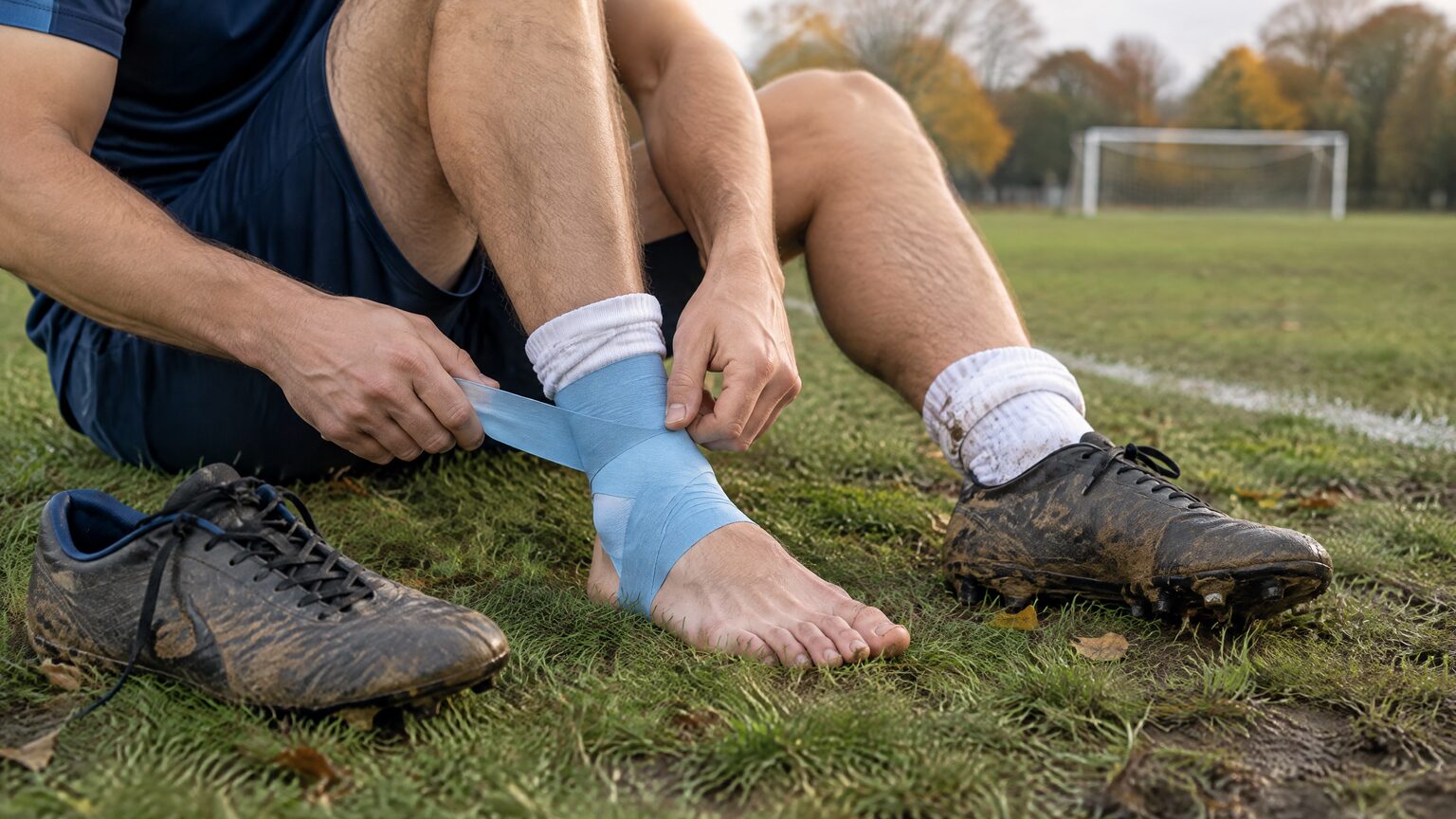
You went over on your ankle at Sunday football three weeks ago. It's fine walking round the shops now, but by the evening it's puffy again and you still don't trust it on a turn.
Or it's the calf that went tight at parkrun. You gave it a fortnight off, felt nothing, went out for your first proper run back and there it was again at the same lamp post.
If that sounds like you, you're probably asking yourself the same question most of my patients ask before they ring us: is this just taking its time, or is something not right? Let me help you answer that.
The short answer: most sprains and strains feel a lot better within about two weeks. If yours isn't clearly improving by then, keeps coming back every time you return to your sport, or you can't put weight on it, it's worth getting it properly assessed rather than giving it "one more month". A few signs mean you should go to A&E straight away, and I've listed those further down.
How long should a sports injury take to heal?
For most everyday sprains and strains, things feel noticeably better after around two weeks. The more severe ones can take months to get back to normal, so a slow recovery on its own doesn't mean anything is wrong.
What matters is the direction of travel. Is it a bit better each week? Can you do a little more each time without it flaring up the next day? If yes, you're probably on track. If it's stuck where it was a fortnight ago, or it's better until you try your sport and then it's straight back to square one, that's your cue.
Why do some sports injuries keep coming back?
This is the one I see most often, and it's the most frustrating for people, because they've done the sensible thing and rested it.
Here's the problem. Rest settles the pain because you've stopped asking the injured bit to do anything. But the research on soft tissue injuries is pretty clear that a short spell of protection, a day to three days, is useful, and long spells of rest can actually leave the tissue weaker. So you rest, it feels fine, you go back to full training, and you're asking something that's lost strength to do the most demanding thing you ever ask of it. No wonder it complains.
The other reason is that the area that hurts isn't always where the problem is. A lot of the time, especially in the lower limb, it comes down to biomechanics: how the whole leg and body share the load. If one area isn't doing its share, because it's weak, stiff or not controlling movement well, another area picks up the extra load and that's the bit that gets sore. That's why people get the same injury in the same place again and again. They rest, the sore area settles, they go back to their sport, and nothing has changed in the area that was overloading it, so it comes straight back. The good news is that this is something you can change. I wrote about this with runners' knees, and you can read that article here if you want to know more: Why Runners Get Knee Pain.
Should you rest a sports injury or keep moving?
Both, in the right order. For the first one to three days, protect it and don't push into pain. After that, start moving it again gently as the pain allows, so it doesn't stiffen up, and build up gradually.
What you're aiming for is a steady climb. Walk before you jog, jog before you sprint, straight lines before you twist and turn. If something sends it backwards for a couple of days, you did too much too soon. Ease off one step and build again.
When to get a sports injury checked
Book in and get it looked at if:
- It isn't clearly better after about two weeks of looking after it yourself
- It keeps coming back every time you go back to training or matches
- The pain or swelling is getting worse rather than better
- It feels very stiff or you're struggling to move it
- You've had the same injury in the same place before
- You've got an event or a season coming up and you want to know where you actually stand
You don't need a GP referral to see us. You can book straight in.
When not to wait: go to A&E or call 999
Some injuries need hospital care, not a clinic. Go to A&E or call 999 if:
- You heard a crack when it happened
- The injured part has changed shape or is pointing at an odd angle
- It's numb, tingling or has pins and needles
- The skin around it has turned blue or grey, or is cold to touch
Get urgent medical advice the same day if you can't put any weight on it or walk more than a few steps, the swelling or bruising is large or getting worse, or you've also got a high temperature or feel hot, cold or shivery. Don't drive yourself if you're going to A&E. Get someone to take you.
How we approach sports injuries at BodyCare
When you come in, we start with your story. How it happened, what you've tried, what makes it better or worse, and what you want to get back to doing. Your goal shapes the plan, whether that's a half marathon, Saturday football or just getting round the garden without thinking about it.
Then we test the whole picture, not just the sore spot. We look at how the joints above and below are moving, what's strong and what isn't, and how you load it. We measure things so we can retest them, which means you'll see in numbers whether it's working, not just whether it feels better on the day.
You'll leave with a straight answer: what we think is driving it, what the plan is and roughly how long it should take. And if we think you need an opinion beyond BodyCare, a scan we don't do or a surgical view, we'll tell you that too.
If you've been here before with an injury that's healed but still hurts, this article might help as well: Why It Still Hurts When the Injury Has Healed.
Sports injury FAQs
Do I need a GP referral to see you?
No. You can book an assessment directly.
How long should a sprain or strain take to get better?
Most feel noticeably better within about two weeks. Severe ones can take months. If yours isn't improving week on week, get it checked.
Should I rest completely?
Protect it for the first one to three days, then start moving it gently as pain allows. Long spells of complete rest can leave the tissue weaker.
Where are you, and is there parking?
We're on Bury Road in Kentford, around five minutes' drive from Newmarket via the A14, with free parking right outside. People come to us from Newmarket, Bury St Edmunds, Mildenhall, Red Lodge and the villages in between.
When should I go to A&E instead?
If you heard a crack, it's changed shape, it's numb or tingling, or the skin has gone blue, grey or cold. Don't wait for a clinic appointment for those.
If this sounds like your injury
If you've rested it, it felt better, and it's come straight back the minute you tried your sport, you don't need another month off. You need to know why it keeps happening. That's what our sports injury clinic near Newmarket is set up to find out.
Book an assessment with us at BodyCare. Call us on 01638 724042 or book online.