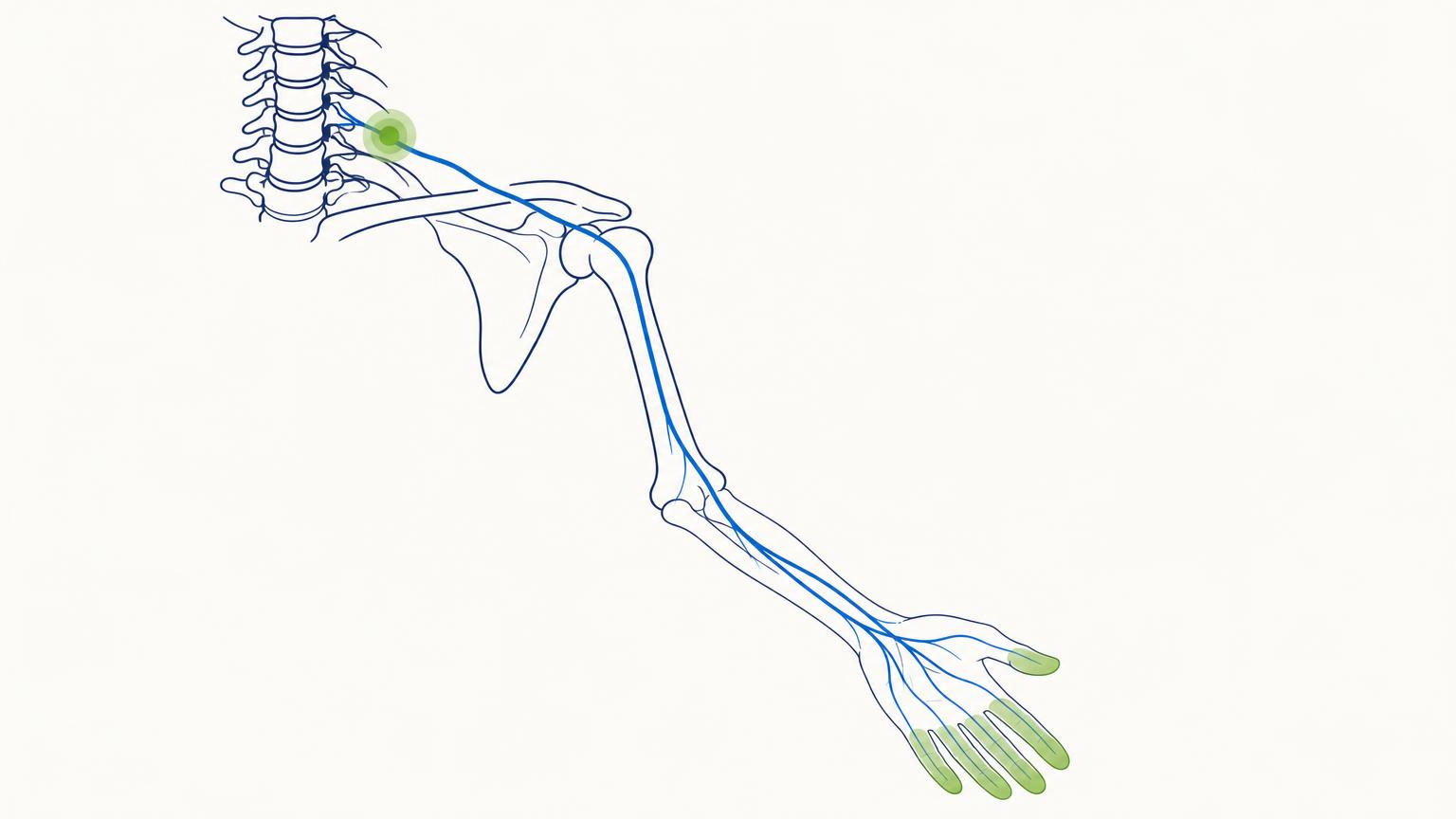
It usually starts as an ache. Around the shoulder blade, or down the outside of the arm, or through the forearm. Then the fingers begin tingling, sometimes worst at night, and you catch yourself shaking your hand out to clear it. The kettle feels less secure in your grip than it did. Reversing the car has become an awkward movement rather than an automatic one.
And your neck feels perfectly fine.
That last part is what sends people down the wrong road. They arrive at a clinic certain they have done something to their shoulder, or that they have a trapped nerve at the elbow, because the shoulder and the elbow are where they can feel it.
Where you feel it and where it comes from are two different places
A nerve leaves the spine in your neck and runs the whole way down into your hand. Irritate or compress that nerve anywhere along its route and the symptoms show up further down the line, in whatever patch of skin and group of muscles it happens to supply. The place it hurts is simply the end of the wire. It is not where the fault is.
So a nerve being pinched at the neck can produce a deep ache in the shoulder, pins and needles in two fingers and a grip that keeps letting you down, while the neck itself barely complains at all. Turning your head might be a little stiff. It might be entirely comfortable.
Two wires taped together, and you cannot tell from the outside which one you have annoyed.
Why it gets missed
It is easy for an assessment of a tingling arm to stop at the hand. Fingers are tested, a nerve compressed somewhere near the wrist or the elbow gets the blame, and treatment starts at that level. Sometimes that is right. Sometimes it is not, and the clue that would have separated the two was a few inches further up the arm.
There are two of those clues, and they take a couple of minutes between them.
The first is the map. The nerve people think of at the elbow, the one responsible for the funny bone sensation, only covers the hand. The little finger, half the ring finger and the outside edge of the palm. It covers nothing on the forearm at all, because the skin on the inner forearm is supplied by a different nerve that branches off much higher up, well above the elbow. So any symptom on the inside of the forearm puts the problem above the elbow, and that points straight back at the neck.
The second is the thumb. There are small muscles in the fleshy pad at the base of the thumb that are wired from the same neck levels involved in this problem, but they travel down a completely different nerve that goes nowhere near the elbow. If those thumb muscles are weak, the problem is at the neck. If they are strong while the little finger side of the hand is weak, the problem is at the elbow.
Checked properly and compared side to side, those two things often settle the question on the day.
Most people did nothing to cause it
A large population study tracked 561 people diagnosed with this condition in one American city over fifteen years, and followed them up for a median of almost five years. Three of its findings are worth knowing if you are in the middle of it.
The first is that only around 15 in every 100 had any physical exertion or injury before the symptoms started. So if you have spent a fortnight going back over what you lifted or how you slept, for most people there is nothing obvious to find. It was also most common in people in their early fifties.
The second is the outlook, and it is better than most people fear. At their last follow-up, 9 in 10 were either free of symptoms or only mildly affected, and around three in four did not have surgery.
The third is why it is worth getting it properly looked at. Around a third had it come back at some point during follow-up, so knowing where it is coming from, and what keeps it settled, matters.
Getting the level right changes the treatment
If everyone assumes shoulder, the treatment goes to the shoulder. Exercises for a shoulder that was never the problem, hands-on work on a joint that was never irritated, and a nerve in the neck carrying on exactly as it was. The symptoms persist, and the conclusion drawn is usually that this is a stubborn shoulder rather than the wrong target.
The same applies at the elbow. Splints, activity changes and rest for a nerve that is being compressed much higher up.
Working out which level is driving it is the whole job of the assessment. It is also what tells us whether decompression is appropriate for you, because when gently taking the pressure off the neck eases the arm, that is one of the clearest signs we get that treatment aimed at the neck is the right call.
How we approach it at BodyCare
We take a proper history first, because most of the answer is in it. Which came first, the neck or the arm. What position changes the hand symptoms, the neck or the elbow. What you cannot currently do that you could do three months ago.
Then we test the whole route rather than the end of it. The sensory map including the forearm and upper arm, not just the fingers. Grip and the individual muscle groups, measured and written down so we can retest them and show you whether they are moving. Neck movement, and how the arm responds to it.
From there you get a straight answer about what is driving it, what we expect to change and roughly how long that should take. If it is a disc in the neck pressing on the nerve, we will tell you whether decompression is appropriate for you and why. If the problem is at the elbow after all, we will say so and treat that instead. If we think this needs an opinion beyond what we do here, we will tell you that too.
One thing worth saying plainly. If you develop weakness that is clearly getting worse, growing clumsiness in the hands such as dropping things or struggling with buttons, or any change in your balance or the way you are walking, get seen promptly rather than waiting. That combination is uncommon and it needs looking at sooner.
If this sounds like your arm
You have probably already been told it is your shoulder, or your posture, or that it will settle on its own. It may well settle. The question is whether anyone has established where it is actually coming from, because the answer to that decides everything that happens next.
Book an assessment with us at BodyCare. We will find the level, tell you plainly what recovery looks like, and treat the place the problem is rather than the place you can feel it. Call us on 01638 724042 or book online.